100% Original, Ready to Ship!

FANUC Advances AI Robotics And Intelligent Packaging Automation For Smart Manufacturing
FANUC America has announced plans to demonstrate AI-powered robotics, collaborative robots, machine vision, and food-grade automation technologies at PACK EXPO International 2026 in Chicago. The demonstrations focus on helping packaging and processing manufacturers address labor shortages, improve production flexibility, and automate repetitive handling operations.
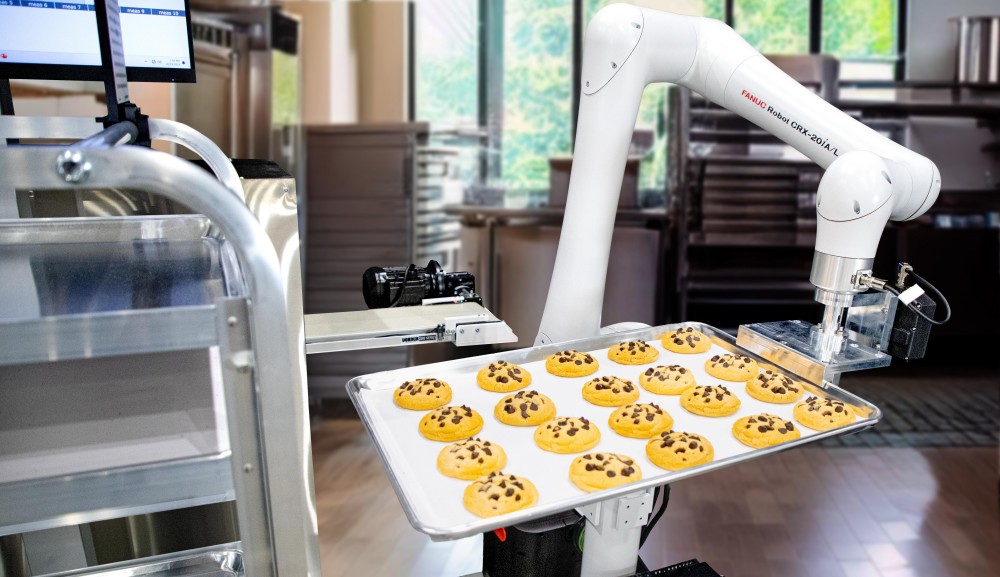
The announcement reflects a broader shift in industrial automation toward integrated systems that combine robotics, intelligent vision, control hardware, and AI-assisted programming. Rather than automating a single task, manufacturers are increasingly evaluating complete production workflows, from product identification and picking to packaging, inspection, and palletizing.
AI-Assisted Programming for Industrial Robots
One of the featured applications involves FANUC’s CRX-20iA/L collaborative robot, which is designed to handle payloads of up to 20 kg. According to the company, the demonstration uses natural-language instructions and generative AI to translate requested production configurations into Python code and corresponding robot actions.
This approach illustrates how AI-assisted programming may make robotic automation more accessible to manufacturers that lack extensive in-house robotics expertise. It could also help engineering teams explore new production configurations more efficiently.
However, AI-generated instructions still require appropriate engineering review, testing, and validation before deployment. Robot motion, tooling, workspace limits, and safety functions must be configured for the specific application. Conventional controllers and safety systems remain essential for reliable industrial operation.
Collaborative Robots and Machine Vision
FANUC will also demonstrate coordinated collaborative robots performing multiple stages of a packaging process. The application combines vision-guided picking, label orientation verification, packing, and palletizing within an integrated work cell.
Machine vision helps automation systems identify products, verify package information, and respond to changes in item position. When combined with robotic motion control, these capabilities can reduce the need for manual handling and improve consistency across repetitive production tasks.
Another demonstration uses dynamic proximity monitoring, machine vision, barcode verification, and motion planning to adjust a robot’s path around workers in a shared workspace. Such applications highlight the importance of coordinating productivity objectives with a properly engineered safety strategy. Collaborative robot technology does not automatically make every application safe; a risk assessment and suitable protective measures are still required.
Food-Grade Robotics for Packaging Lines
Food processing is another major focus of the planned demonstrations. FANUC will present applications involving delta robots, SCARA robots, and food-grade industrial robots for product placement, case packing, and palletizing.
The company describes a demonstration using a stainless-steel DR-3iB/6 delta robot with an IP69K rating, coordinated with a food-grade SR-12iA/C SCARA robot to place products into packages. Additional applications use vision technology to identify randomly oriented packages on a moving conveyor before placing them into cases.
For food manufacturers, automation can help improve repeatability, reduce repetitive manual work, and maintain product handling consistency. Equipment selection must nevertheless account for washdown procedures, hygiene requirements, gripper design, cleaning chemicals, and the environmental conditions of the production area.
Implications for PLC and Automation System Integrators
FANUC also plans to feature its R-50iA and R-30iB Mini Plus controller platforms alongside technologies such as iRVision, iRPickTool, and PalletTool 3.
For system integrators, these demonstrations show why successful packaging automation depends on more than robot selection alone. PLCs, robot controllers, sensors, barcode readers, vision systems, conveyors, HMIs, and safety equipment must exchange information reliably and operate according to a coordinated sequence.
Before implementing a robotic packaging cell, engineering teams should verify communications compatibility, cycle-time requirements, product changeover procedures, safety zoning, and maintenance access. These checks help ensure that individual devices work together as a dependable production system.
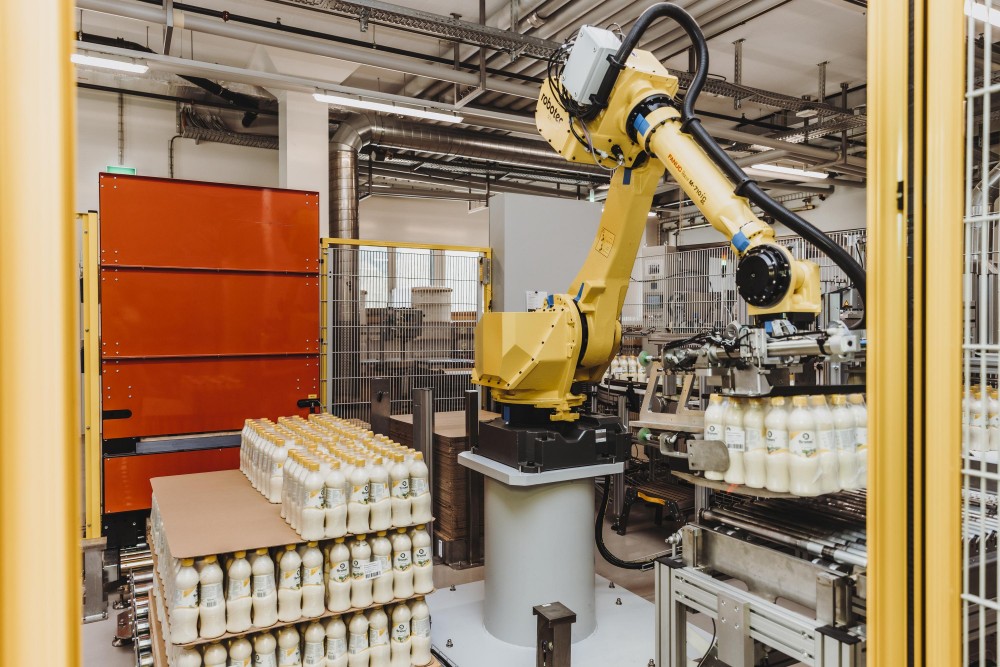
FANUC’s planned PACK EXPO demonstrations highlight the growing role of AI, collaborative robotics, and machine vision in packaging automation. For manufacturers seeking greater flexibility and more efficient production, integrated robotic systems are becoming an important option in the development of smart factories.
 Rockwell Automation Expands Industrial AI Capabilities With NVIDIA Nemotron Support
 Rockwell Automation Introduces FactoryTalk Conductor To Advance AI-Driven Industrial Automation
 ABB And Boliden Advance DCS Modernization With Ethernet-APL Industrial Automation
 Bosch Rexroth Expands ctrlX AUTOMATION With New Safety PLC, Drive And Software Features